


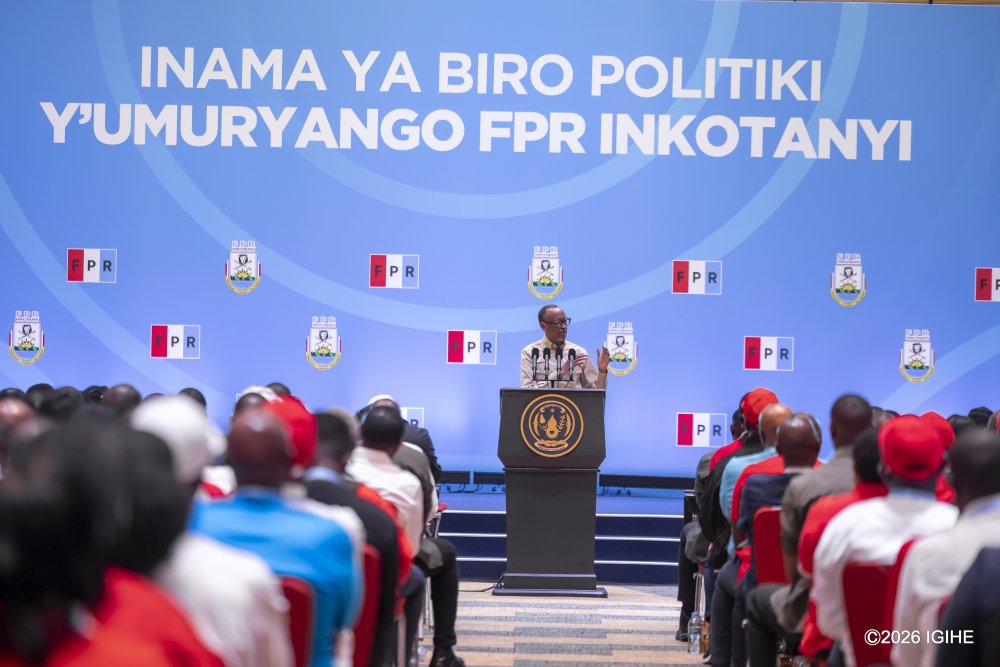
President Paul Kagame dismissed those who believe they can silence him over efforts to dismantle the FDLR, a terrorist group founded by individuals linked to the 1994 Genocide against the Tutsi in Rwanda, which he says poses a security threat to the country. He said the only way to silence him would be through his death.
p he says has been given space in the DRC and poses a threat to Rwanda’s national security.
“I often return to this issue when speaking with different people. I ask them: why do you continue to make this a problem of Rwanda? This is not Rwanda’s problem; it is a problem of Congo and its people. For us, it becomes an issue when it comes to the FDLR, which must be addressed one way or another. You, the Congolese, can solve it yourselves, or the United Nations, which is there… Stop interfering in our country, or we will resolve it ourselves. That is how we became involved in this matter,” Kagame said.
He added that during various peace talks between Rwanda and the DRC, it became clear, in his view, that there was a major challenge involving Congo’s commitment to peace.
“Congo has never truly wanted peace. It continued supporting the FDLR in fighting against us, and later joined forces with soldiers from other countries. I believe you know the story of Goma. However, we asked them: at least help us resolve the FDLR issue, and then our own matters will be settled,” he said.
In December 2025, Rwanda and the DRC signed a peace agreement in the United States aimed at ending tensions between the two countries.
The agreement was expected to provide a lasting solution to the crisis in the region, as it included commitments to dismantle the FDLR armed group, Rwanda’s withdrawal of defensive measures, and cooperation between the countries on initiatives aimed at promoting economic development.
President Kagame said that, later, some people began changing the terms of what the countries had agreed upon, particularly the commitment to dismantle the FDLR and for Rwanda to remove its defensive measures.
He said the narrative has now shifted, with some calling for Rwandan troops to withdraw from DRC territory before the FDLR is dismantled, which he described as contrary to the agreement.
President Kagame said those making such demands appear to believe that AFC/M23 forces would also leave DRC territory and be relocated to Rwanda.
“That is what is behind this; they think we will bring M23 here,” he said.
He further argued that the debate over whether M23 members are Congolese or not is not his responsibility, noting that many historical events occurred before he was born. He said Rwanda should not be held accountable for those issues, but rather those who were present during the colonial period should address them.
“I will only be silent when I am dead…”
President Paul Kagame said that even before Rwanda and the Democratic Republic of Congo signed the peace agreement in December 2025, Rwanda had provided information about possible developments in Uvira, including the deployment of government forces and troops from Burundi. However, after Uvira was taken by AFC/M23, he said the situation was being used as an excuse to accuse Rwanda of failing to respect the peace agreement.
He said the signed agreement appeared to be a positive step for both countries and the wider region, but suggested that there may have been other motives behind the scenes.
The President said that although the goal was to stop both M23 and FDLR, it now appears that all sides have united against M23, while the FDLR continues to cooperate with the government, something he said is widely known.
“All of this is known, but the difficult part is that some people think they can use intimidation to prevent the truth from being told, to decide what should be done, and force others to remain silent. That is what is happening. Today, when you try to ask questions, they immediately say: ‘You know what will happen next, I will impose sanctions on you,’” he said.
Kagame also referred to sanctions imposed on Rwanda by the United States, saying they have created a climate of fear that prevents people from speaking openly.
He further mentioned Rwanda’s efforts to provide information about developments in Minembwe, saying the warnings were ignored because some people argued that the issue was not Rwanda’s concern.
He said: “They said it was not your concern. They never even said: ‘Do you know that people are being killed, or are you just making things up?’ No, they said it was not your problem. But if it does not concern me, yet it could affect you, what happens when you do nothing while the situation continues to get worse?”
He said that silencing people instead of implementing what both sides agreed upon could make the situation become worse than many people expect.
“Silencing people, I think, is going to become a problem, or become more serious than people imagine. Saying that we will support those who want to come and kill them, as they did in the past, and that we will solve it the way we want while telling you to remain silent… I will only be silent when I am dead. That is the only way to silence me,” he said.
He emphasized that Rwanda is a small country that can face many challenges, but added that destroying Rwanda again is something that cannot happen.