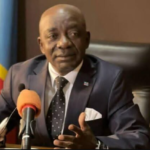



Congolese political analyst Christian Moleka has warned that the Democratic Republic of Congo (DRC) is facing two major challenges that could have serious consequences for its future. These include the risk of the country becoming fragmented and the possibility that the conflict in eastern DRC could continue for a prolonged period, affecting governance, security, and the development of democracy.
Moleka made the remarks during a press briefing on Friday, where he discussed his assessment of the security situation in eastern DRC and the potential impact it could have on the country as a whole.
Christian Moleka said that the issue of parts of the country being controlled by armed groups or other forces is no longer merely a future concern. He said there are signs that the loss of the government’s ability to control certain areas of the country is becoming increasingly serious.
He said:
“These were things that seemed far-fetched in 2024, after the 2023 elections. But today, the issue of territories being taken over in a tangible way is becoming increasingly serious.”
The analyst said he considers this trend to be the most serious challenge facing the country, as it could weaken the DRC government’s ability to effectively control some of its territories.
He explained that the issue is not only the war in eastern DRC, but that the greater concern is when a country begins to lose authority over parts of its territory, as this could raise further concerns about its territorial integrity.
Moleka gave the example that if a country lacks sufficient capacity to protect its territorial integrity, neighboring countries or other partners could develop positions or interests that may have consequences for its territory.
He said that, in the long term, this could lead to what he described as:
“A gradual process of the country’s territory shrinking.”
Moleka said this could be a more serious problem than the conventional idea of a country collapsing, because it could happen gradually through the loss of control over different parts of the country.
On the other hand, Christian Moleka said another major concern is the possibility of the conflict in eastern DRC continuing for a long time, as this could force the country to shift its priorities, sidelining development programs and good governance.
He noted that a prolonged war could affect elections, national development, and the functioning of state institutions.
He said:
“The idea of making development a government priority could be pushed aside.”
He added that prolonged conflicts can change the way the government operates as well as how citizens perceive state institutions.
Christian Moleka compared the current situation with other conflicts that occurred in eastern DRC, including the CNDP rebellion in 2008–2009 and the M23 rebellion in 2012–2013.
He said that although those conflicts were serious, they did not last as long or involve control over such large areas as he believes is happening today.
He said:
“To see territory being controlled on this scale, you would have to go back to the period around 1998.”
The analyst said the duration of the conflict is a very important factor, as a prolonged war can lead to changes in people’s way of life, the functioning of local institutions, and governance in areas where the state no longer exercises effective control.
He highlighted that a prolonged conflict could lead to:
- Changes in the way people live;
- Changes in local governance;
- Changes in the functioning of the justice system;
- The strengthening of non-state authorities.
He said:
“Time is no longer on our side. This is not like the 2012–2013 rebellion, which lasted for a relatively short period. This is a long-term problem, and a prolonged conflict is not good for Kinshasa.”
Christian Moleka’s analysis highlights concerns that have long been raised about security, territorial integrity, and the future of the Democratic Republic of Congo.
As the conflict in eastern DRC remains a major political and security challenge, various analysts continue to question whether the DRC government will be able to fully restore its authority over its territory and prevent the long-term consequences of the conflict.