


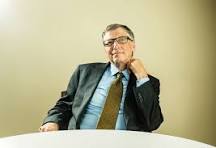
Billionaire Bill Gates is in Rwanda on a visit aimed at assessing the country’s progress in improving healthcare services. As part of his first activities, he visited a syringe manufacturing factory located in Rwamagana District.
According to reliable information obtained by ge level.
The visit is a private trip by Bill Gates, and people who have met him say that despite being one of the world’s most influential figures, he has kept the visit very simple. His schedIGIHE, in addition to visiting the syringe manufacturing factory inaugurated in 2025, which produces syringes exported to different African countries, Bill Gates is also expected to visit Mwulire Health Center and meet with a community health worker to understand how Rwanda’s healthcare system operates from the villaule includes meeting and sharing meals with different people at a hotel in Rwamagana.
The projects Gates visited in Rwanda are among the initiatives supported by the Gates Foundation, where he serves as Chair of the Board.
The TKMD factory he visited is located in the Mwulire Industrial Park in Rwamagana District. It was officially opened on April 1, 2025, with an initial production capacity of between 600,000 and 1 million syringes per day.
The factory started operations with 110 employees, of whom 80% are women. The syringes produced undergo quality inspections to ensure they meet international standards before being approved for the market.
The first syringes produced by the factory were purchased by UNICEF for distribution to countries including Ethiopia, Burundi, the Democratic Republic of Congo, and Mozambique.
According to CNBC Africa, TKMD has produced more than 22 million syringes since 2024 and has secured a UNICEF contract to manufacture an additional 150 million syringes.
It is expected that producing these syringes in Rwanda will reduce the time required to deliver them to countries in East, Central, and Southern Africa by up to 90%.
Bill Gates said that the COVID-19 pandemic highlighted the importance of having reliable systems for producing and distributing medicines, vaccines, and other essential healthcare supplies.
He noted that when African countries struggled to access vaccines, syringes, and other critical medical equipment, it became clear that relying on supplies manufactured in distant countries could put people’s lives at risk.
According to Gates, factories such as TKMD do more than manufacture medical supplies; they also create jobs, strengthen Africa’s ability to respond to pandemics and other health challenges, and contribute to long-term economic development.
Bill Gates Praises Rwanda’s Progress in Healthcare
Before arriving in Rwanda, Bill Gates said he wanted to learn from the country’s approach of investing in its people, building strong institutions, and implementing programs that directly reach communities.
He noted that since 2000, deaths among Rwandan children under the age of five have declined by 80%, while maternal deaths related to pregnancy and childbirth have decreased by 85%.
“What impresses me is not one specific achievement, but rather how the country’s long-term investment in its people, strong institutions, and delivery of services to communities is creating visible change,” Gates said.
He explained that these achievements have been made possible through increased investment in primary healthcare, support for community health workers, and the strengthening of institutions such as the Rwanda Biomedical Centre (RBC).
As part of his visit, Gates plans to tour Mwulire Health Center and meet with a community health worker. He aims to understand how healthcare services are delivered closer to communities, how pregnant women are monitored, how diseases are detected early, and how patients are referred to higher-level health facilities.
Gates also said he looked forward to meeting government officials, frontline healthcare workers, researchers, students, and innovators.
“I look forward to gaining a deeper understanding of how they work, both individually and collectively, to continue improving the lives of citizens,” he said.
Bill Gates’ Visit to Rwanda Highlights the Role of Technology in Healthcare
Gates’ visit to Rwanda is also focusing on how the country uses technology and artificial intelligence to improve healthcare services.
He highlighted the work of the National Health Intelligence Center, which brings together health-related data, including patient information, medical services provided, available medicines and supplies, insurance coverage, healthcare workers, and demographic data.
Combining this information helps leaders make faster decisions based on accurate and reliable data.
The Gates Foundation is also supporting the Horizon 1000 initiative, which aims to equip 1,000 primary healthcare facilities with artificial intelligence-powered tools by 2028.
Gates’ visit comes as the Gates Foundation announced plans to invest $200 billion over the next 20 years, with a significant portion expected to support initiatives that benefit Africa.
Gates said that while support from development partners will continue to play a role, Africa’s long-term progress will depend on strong leadership, effective institutions, and solutions designed by Africans themselves.