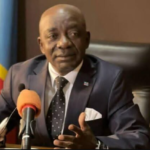



Lambert Mende Omalanga, a former Minister of Communication and Government Spokesperson of the Democratic Republic of the Congo (DRC), and currently a national lawmaker, has said he does not support the idea of a political dialogue involving former President Joseph Kabila and Corneille Nangaa, coordinator of the Alliance Fleuve Congo (AFC).
In an interview about the political challenges facing the country, Lambert Mende said that the two politicians should not be invited to political talks because, according to him, they have been convicted by courts in the Democratic Republic of the Congo and are also subject to international sanctions. In his view, these factors alone mean they should no longer be regarded as legitimate partners in discussions about the country’s future.
“It is not possible for people who have been convicted and are under international sanctions to be among those discussing the future direction of the country.”
Lambert Mende Omalanga is one of the Congolese politicians who has played a prominent role in the country’s politics for many years. He served as Minister of Communication and Government Spokesperson during Joseph Kabila’s presidency, spending several years explaining the government’s policies and actions both domestically and internationally.
Although he worked closely with Joseph Kabila when he was president, Mende now appears to have taken a different position from the former head of state, particularly regarding possible talks between the government, the opposition, and armed groups.
Lambert Mende became widely known as one of the senior officials in Joseph Kabila’s administration between 2007 and 2019, when he served as one of the government’s leading spokespeople.
Corneille Nangaa also previously served as president of the National Electoral Commission (CENI) during Joseph Kabila’s administration before joining the Alliance Fleuve Congo (AFC), where he currently serves as coordinator.
Mende currently disagrees with Joseph Kabila and Corneille Nangaa over how the crisis in the Democratic Republic of the Congo should be resolved.
Lambert Mende’s remarks highlight the continued deep disagreements among political actors in the DRC over how to address the country’s security and political challenges.
Some political figures support an inclusive dialogue involving all sides, including the opposition, arguing that it could help achieve lasting peace. Others, including Lambert Mende, maintain that people who have been convicted or are under international sanctions should not participate in such talks.
This could further delay a broad political consensus among the various parties at a time when the country continues to face security challenges, particularly in its eastern regions.
At present, the Alliance Fleuve Congo (AFC/M23) coalition controls large parts of eastern DRC. Its role in controlling certain areas and engaging with international mediators has kept it at the center of discussions about the country’s political future.
Meanwhile, the government of President Félix Tshisekedi continues to insist that the crisis should be resolved while respecting the country’s sovereignty and state institutions. Opposition groups, however, continue to criticize the government’s handling of the security and political situation.
Overall, Lambert Mende’s remarks show that disagreements over the format and participants of political dialogue are becoming increasingly intense. The key question remains whether a way can be found to bring the different sides together for talks aimed at building peace, or whether disagreements over who should participate will continue to delay reconciliation and stability in the Democratic Republic of the Congo.